Top Ecommerce Tasks to Outsource Right Now
Spending more time on operations than on growth? Discover the top ecommerce tasks and think what it is actual task costing you to keep them in-house?


Most ecommerce business owners start the week with one goal: grow the business. But by Tuesday, the day is consumed by ecommerce tasks that have nothing to do with growth. If that sounds familiar, you're not behind. You're just doing too much. This guide breaks down exactly which ecommerce tasks to outsource, what each one costs you to keep in-house, and how to hand them off without losing control.
If you feel like you’re always busy but your ecommerce business isn’t really moving forward, you’re not alone. Many business owners go through this. The difference is that some figure out when to step back, stop doing everything themselves, and start outsourcing tasks.
In this guide, you’ll see which ecommerce tasks you can outsource, why it helps, and how to get started without overcomplicating things.
Why Ecommerce Brands Are Outsourcing More Tasks Than Ever Before
Running an online store isn't just about selling products.
You have to handle multiple platforms, stay up to date with trends, manage orders, and ensure customers have a good experience.
It is not just one job; it feels like doing several jobs at once.
The fastest-growing brands do not rely on bigger teams; they focus on making smarter decisions.
They know what to handle themselves and what to outsource.
That's why outsourcing today is less about convenience and more about growth.
Research shows that many businesses outsource time-consuming and technical tasks to work more efficiently, grow easily, and reduce costs.
It helps them to focus on building products, improving marketing, and taking care of their customers.
The Hidden Cost of Not Outsourcing Ecommerce Tasks
Most business owners only think about how much outsourcing costs. But very few think about what it costs not to outsource.
Every hour you spend updating inventory, handling orders, or replying to basic questions is an hour you are not growing your business.
Doing everything on your own often leads to costly mistakes, especially when the task needs real expertise.
Outsourcing helps cut costs by removing the need for in-house staff, benefits, storage space, and costly software.
And unlike hiring full-time employees, outsourcing lets you scale operations up or down quickly to handle seasonal surges without the challenges of hiring or layoffs.
5 Clear Signs It's Time to Outsource Your Ecommerce Tasks
If you are always busy but not making real progress, missing customer expectations, or struggling to grow, your business is trying to tell you something.
Here are five clear signs that indicate it's time to delegate.
You Spend More Time on Admin Than on Growing Sales
If most of your time goes into administrative tasks like updating listings, answering emails, and tracking orders, it’s a warning sign. These tasks are important but they shouldn’t take over your entire day.
Skilled virtual assistants or outsourced ecommerce teams can take over these time consuming tasks immediately, freeing you up for the work that actually grows your revenue.
Errors and Customer Complaints Are Increasing
When you get more orders than your team can handle, mistakes start to happen.
Late shipments, wrong items, or slow responses often lead to negative feedback and a poor customer experience.
Each error takes away the trust that took months to build.
When customers are not satisfied, they are less likely to buy again and may lose trust in your brand. Outsourcing these tasks to skilled professionals helps reduce errors and improve accuracy.
Your Team Can't Keep Up With Demand
Getting a lot of orders at once is great, but it can put too much pressure on your team. When employees are stretched thin, work slows down, morale drops, and customer suffers.
With outsourcing, you get a team that can quickly adjust to your business needs, helping you manage busy periods without stress.
Expanding to New Channels Feels Out of Reach
Expanding to new sales channels like Amazon, eBay, or Walmart can boost revenue, but managing multiple channels is not easy. Each platform has its own rules, listing formats, and updates.
If expansion feels confusing or delayed, it is a strong sign you need help. Outsourced ecommerce experts can manage these platforms efficiently, so you can grow without getting stuck in complexity.
A Quick Checklist to Know When to Outsource Ecommerce Tasks
Use this checklist to decide if it is time to start outsourcing:
- You’re working more than 50 hours a week just to keep things running.
- Customers are waiting over 24 hours for a response.
- You have made inventory mistakes recently.
- You do not have time to add new products to your store.
- You know what to delegate, but don’t have the right help.
- Revenue is growing, but your profits are not improving.
- You have been putting off expanding to new sales channels
If you relate to three or more of these, it’s probably time to start outsourcing. The longer you wait, the more it can slow down your growth.
Top Ecommerce Tasks You Should Outsource Today
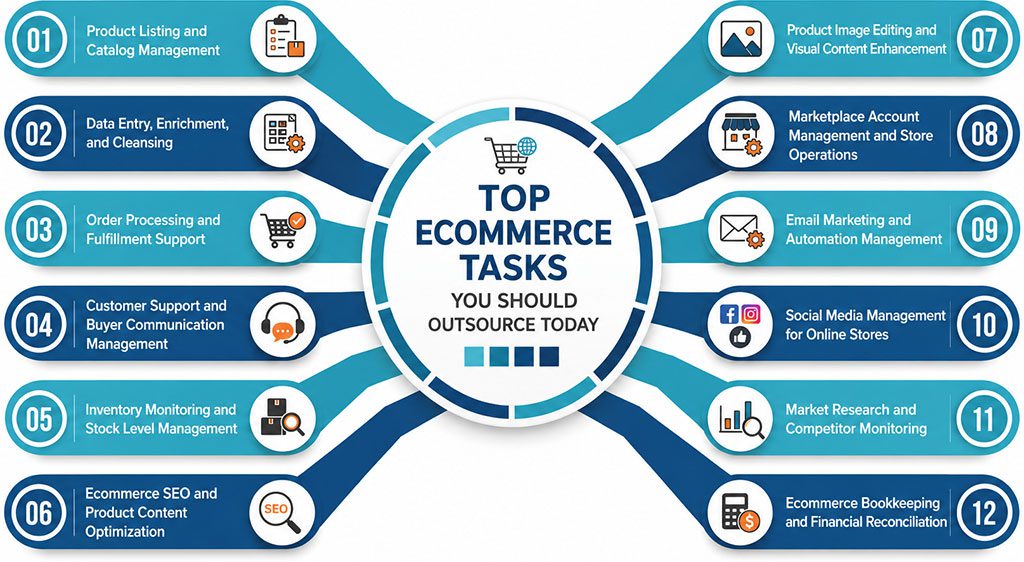
Here are the most impactful ecommerce tasks you can outsource right now, along with exactly what each covers and why it matters.
1. Product Listing and Catalog Management
Your product listing is often the first thing a customer sees. Poorly written titles, missing attributes, and inconsistent formatting drive potential customers away before they even read your description.
Product listing and catalog management include everything needed to keep your store organized and customer-friendly, such as:
- Product upload across Shopify, WooCommerce, Magento, and marketplace platforms.
- Attribute mapping to ensure every specification, like size, color, material, and compatibility, is accurate and consistent.
- Organizing products into the right categories for easy navigation.
- Regular catalog audits to remove errors or outdated information.
A virtual assistant can manage item listings, ensuring they are appealing and accessible, which is crucial for the success of an ecommerce store.
Need help managing your product catalog at scale? Explore Product Listing
2. Data Entry, Enrichment, and Cleansing
This is one of the most underestimated problems in ecommerce. You may not notice it immediately, but poor product data quietly affects everything from search rankings to customer trust. No matter how much you spend on ads, messy data will reduce conversions.
- Standardizing product data across all platforms to ensure consistency.
- Deduplicating catalog records to remove duplicate listings.
- Formatting product attributes to meet marketplace requirements (Amazon, Walmart, Google Shopping, etc.)
- Enriching listings with detailed descriptions, enhanced specs, and relevant keywords.
- Normalizing units of measure, brand names, and category taxonomies.
Is your product data holding back your sales? Visit No 1 Ecommerce Data Entry Company
3. Order Processing and Fulfillment Support
One small mistake in order processing can cost you a customer. That's how critical this part of your ecommerce business is.
Outsourcing order processing and order fulfillment helps keep everything running smoothly behind the scenes. From verifying payments to order tracking, every step is handled with consistency and speed.
- Managing orders across multiple platforms.
- Checking payments and spotting possible fraud before sending the order.
- Generating shipping labels and coordinating with fulfillment partners.
- Tracking orders and updating customers.
- Handling returns, refunds, and exchanges.
Automating order processing helps reduce manual work, deliver orders faster, and create a better overall experience. Automation ensures that every order follows the same process with minimal risk of human error.
4. Customer Support and Buyer Communication Management
Customer support is one of the most valuable and time-consuming tasks in any ecommerce store. When done well, it builds loyalty. When done poorly, it ruins it.
- Handling regular inquiries about orders, products, shipping, and returns.
- Managing live chat, email support, and helpdesk tickets.
- Managing disputes and chargebacks professionally.
- Responding to customer feedback and negative feedback to protect your brand reputation
Outsourced support teams are available 24/7 on email, chat, and social media, so customers get help anytime. This helps reduce response time and keeps customers happy. Quick and helpful replies build trust and encourage customers to buy again.
Routine inquiries, such as delivery status or FAQs, can be handled by automated systems while real people handle more complex issues that require human intervention.
5. Inventory Monitoring and Stock Level Management
Running out of stock means lost sales. Overstocking ties up your cash. Both usually occur when inventory is not properly tracked. Outsourcing inventory management helps you stay in control with:
- Real-time inventory tracking and updates.
- Alerts to prevent stockout situations.
- Real-time inventory sync and automatic updates across all platforms, warehouses, and sales channels.
When your inventory is well managed, you can fulfill orders on time and make better buying decisions.
6. Ecommerce SEO and Product Content Optimization
If your products are not visible, they won't sell, no matter how good they are.
Ecommerce SEO is one of the smartest ecommerce tasks to outsource if you want long-term growth.
Outsourcing ecommerce SEO and content covers:
- Keyword research and search intent analysis for product and category pages.
- Improving product details so they appear better on Google Shopping, Amazon, and search results.
- Writing rich product descriptions that are both search-optimized and persuasive.
- A+ content and enhanced brand content creation for Amazon listings.
- Ongoing ranking monitoring and content improvement.
This is where specialists outperform generalists. Strong SEO and content don't just bring traffic; they help boost sales consistently.
7. Product Image Editing and Visual Content Enhancement
In ecommerce, your images are your product. Customers cannot touch or try what they are buying, so your visuals do all the selling.
- Background removal and white background creation for marketplace compliance.
- Color correction and image retouching to ensure accurate product display.
- Creating lifestyle images that show products in the real world.
- Visuals that highlight key features and benefits.
- Bulk image editing for large catalogs.
High-quality visuals reduce return rates, improve click-through rates, and build buyer confidence.
8. Marketplace Account Management and Store Operations
Managing one marketplace account is easy, but handling multiple stores can get complicated. Each one has its own rules and ways of working.
Marketplace management includes:
- Amazon Seller Central, Vendor Central, and FBA management support.
- Fully managing eBay, Etsy, Walmart, and BigCommerce storefront operations are fully managed
- Policy compliance monitoring and account health maintenance.
- Setting up promotions, managing pricing, and improving Buy Box chances.
- Tracking performance and suggesting ways to improve.
9. Email Marketing and Automation Management
Email remains one of the highest-ROI marketing strategies in ecommerce.
But setting up and managing them takes time and strategy. Email marketing covers:
- Email marketing strategies and audience segmentation to improve ROI.
- Creating email campaigns and automation flows.
- Campaign creation, copywriting, and performance tracking.
- List management and deliverability checks.
With proper ecommerce automation, email becomes a powerful tool for improving customer experience and driving repeat sales.
10. Social Media Management for Online Stores
Being active on social media channels is important to stay visible, but social media management can take up a lot of your time as an ecommerce business owner.
- Content planning, creation, and scheduling posts across all major platforms.
- Responding to comments and messages.
- Paid social support,ad campaign setup, targeting, and optimization.
- Influencer outreach and partnership coordination for D2C and marketplace sellers.
Social media tasks are ideal candidates for delegation. When these tasks are handled consistently by a specialist, your brand stays visible and active without consuming your personal time.
11. Market Research and Competitor Monitoring
Staying ahead requires constant awareness of market trends, competitor movements, and shifts in customer behavior. But doing this research properly takes hours that most owners cannot spare.
- Tracking product demand and trends for smarter sourcing decisions.
- Competitor pricing analysis and listing audits.
- Reviewing customer feedback across platforms.
- Monitoring emerging trends across social media, search, and marketplace data.
Thorough market research is done, helping your digital store stay informed about industry trends and competitor strategies. This feeds better product decisions, sharper marketing efforts, and smarter pricing.
12. Ecommerce Bookkeeping and Financial Reconciliation
Orders, refunds, and fees all impact your business, but most business owners don’t see the full picture early on. Ecommerce bookkeeping is not just accounting. It’s about understanding how your online store is actually performing.
- Matching sales data across multiple channels and payment gateways.
- Tracking refunds and platform fees.
- Checking profit margins and product costs.
- Generate monthly reports to understand business performance.
Ecommerce businesses handle high-volume, multi-channel transactions, making manual tracking risky and time-consuming. When your finances are in order, you can confidently invest in growth opportunities, optimize pricing, and focus on boosting sales.
How Much Can You Save by Outsourcing Ecommerce Tasks?
Most business owners don’t realize how expensive “doing it in-house” actually is until they break down the numbers.
In-House Team vs. Outsourcing
When you hire a full-time employee in the US, Australia, Canada or UK for ecommerce operations, you are not just paying their salary. You are paying:
- Base salary is often $35,000–$55,000 per year for entry-level roles.
- Benefits, insurance, and payroll taxes (typically 20–30% on top of salary).
- Equipment, software licenses, and workspace costs.
- Hiring and onboarding time (often 1–2 months before they’re fully productive).
- Training costs for each new platform or process.
Now compare that with outsourcing.
When you outsource the same tasks to a specialist team, cost savings eliminate the need for internal staff salaries, benefits, warehouse rent, and expensive software licenses. Instead, you get access to experienced professionals who can start immediately and you only pay for the work you actually need.
Calculating Your True Cost-Per-Task Before and After Outsourcing
To really understand the difference, look at what each task is costing you today.
Formula:
Your hourly rate or employee cost per hour × Hours spent per month = true monthly cost
For example:
Let’s say your time is worth $75/hour, and you spend 20 hours a month on product data entry. That’s $1,500/month spent on just one repetitive task.
A trained data entry specialist handles the same work for a fraction of that.
Many ecommerce businesses see 40–60% savings on repetitive business tasks after outsourcing, while also reducing errors and improving consistency.
How Outsourcing Reduced Operational Costs for Scaling Ecommerce Brands
Ecommerce businesses that outsource the right tasks often see a clear trend as they grow; their costs don’t increase at the same rate. That’s the benefit of outsourcing.
Unlike in-house teams, where you need to hire more people as work increases, outsourced teams can handle busy periods without adding permanent staff. This makes it easy to scale up or down based on demand.
Businesses can scale operations quickly to handle seasonal surges without hiring or firing staff, a flexibility that in-house teams simply cannot match.
Frequently Asked Questions About Ecommerce Tasks to Outsource
What ecommerce tasks can be outsourced to a virtual assistant?
You can outsource most ecommerce virtual assistant tasks, such as product listings, order processing, customer communication, inventory updates, and social media scheduling. These are common tasks that add to your workload but don’t always need your direct input. Offloading them helps you save time and focus on growing your e commerce store.
How do I figure out which tasks to outsource first?
Start by reviewing your daily work and spotting repetitive, manual tasks. If you’re juggling all the hats, tasks like order fulfillment, customer emails, product info entry, and social media scheduling are the common first-outsource tasks for online store owners. Begin with one or two tasks and expand from there.
Is outsourcing safe for my ecommerce business data?
Yes, as long as you choose a reliable partner. Professional teams follow strict security practices like NDAs, limited access controls, and secure systems. You stay in control while they handle the work, so your business processes remain safe and structured.
How much does it cost to outsource ecommerce operations?
Costs depend on the type of work and volume. Basic manual tasks like product uploads or data entry are usually nominal, while specialized requirements may cost more. The real value comes from reduced manual work, better cash flow, and freeing yourself from what often feels like a full-time job.
Can an outsourced team handle multiple platforms at once?
Yes, experienced teams are used to managing multiple marketplaces like Amazon, Shopify, and eBay at the same time. They understand platform-specific requirements, which keeps your business operations running smoothly without constant supervision.
Can outsourcing helps improve efficiency beyond just saving time?
Yes. Beyond saving time, outsourcing often brings better systems, trained professionals, and smarter workflows. Many providers use automation tools to streamline repetitive work, helping you track inventory, manage orders, and handle business processes more efficiently.
What are the biggest benefits of outsourcing ecommerce tasks?
The biggest advantage is gaining back your time. It reduces manual workload, improves overall efficiency, and helps your business run smoothly while you focus on scaling.
Does outsourcing really improve customer experience?
Yes. Studies show that 93% of customers are more likely to buy again after a good experience, while 78% may drop a purchase due to poor support. Outsourcing ensures faster responses and more consistent support.
How do I know it’s time to outsource?
If you’re spending too much time on day-to-day operations, struggling to respond to customers quickly, dealing with inventory mistakes, or missing shipping deadlines, it’s a strong sign you need support.
Why do ecommerce businesses outsource certain tasks?
Most businesses outsource tasks that are repetitive, time-consuming, or require technical expertise. It helps improve efficiency, reduce operational costs, and makes it easier to scale without overloading your in-house team.
Let Intellect Outsource Handle Your Ecommerce Tasks
Choose Intellect Outsource to manage your essential ecommerce tasks and streamline your operations. Reach out today and discover how they can help take your online store to the next level.
If daily operations are taking up most of your time, it’s a sign your business is ready to scale differently. Outsourcing helps you reduce workload, improve efficiency, and grow with clarity. It is not about whether you can afford to outsource; it is about whether you can afford to keep doing everything yourself.


